
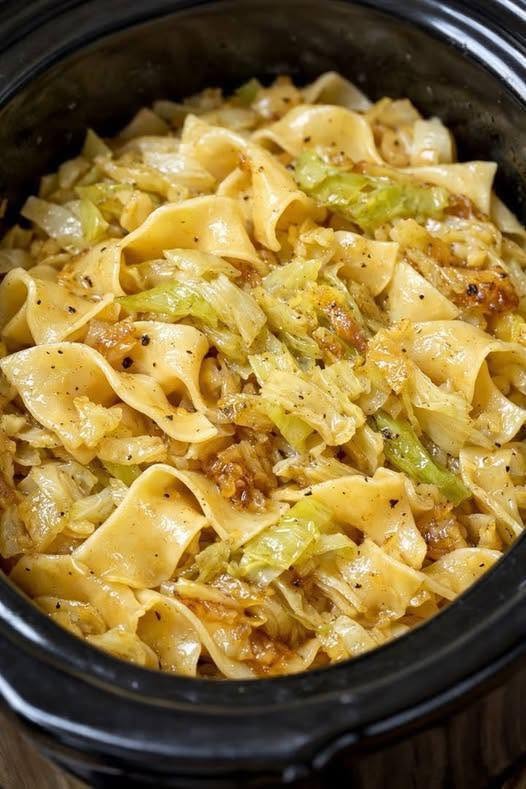
Slow Cooker Amish Cabbage Noodles
Cabbage and noodles is one of those dishes that asks for very little and returns a great deal. The combination — tender green cabbage, wide egg noodles, a generous amount of butter, and a heavy hand with the black pepper — has fed Midwestern and Eastern European households for generations, appearing in various forms under names like haluski, kapusta with noodles, or simply “cabbage noodles” depending on the regional tradition and the family’s heritage. In its Amish-country iteration, it is about as stripped down as food gets: the four ingredients interact with each other over a sustained period of gentle heat, and what results is deeply comforting, surprisingly complex for its simplicity, and genuinely satisfying in the way that only honest, unpretentious food can be.Cookware & Diningware
The slow cooker version builds the dish in layers — alternating cabbage and noodle layers with butter and pepper drizzled between — and lets the enclosed, steamy environment of the covered slow cooker do the work of softening both the cabbage and the uncooked noodles simultaneously. After two and a half to three hours on HIGH, the cabbage has collapsed into silky, slightly caramelized strands, the noodles are glossy and butter-coated, and the whole pot smells of browning butter and sweet cooked cabbage in a way that makes the kitchen a more welcoming place to be.
The Tradition Behind Cabbage and Noodles
The combination of noodles and cabbage cooked together in fat is one of the most widespread dishes in the cooking traditions that stretch from Central Europe through the Midwestern United States — anywhere that German, Austrian, Polish, Hungarian, Czech, or Slovak immigrants settled and carried their food traditions with them. In Central Europe, the dish appears as haluski (a Slovak and Polish preparation), tarhonya with cabbage (a Hungarian version), and various regional variations. In the Amish communities of Ohio, Indiana, and Pennsylvania, the dish became a staple of practical farmhouse cooking where economical ingredients needed to produce filling, satisfying meals for large families working physical labor.
What all these versions share is the same fundamental concept: cabbage cooked in fat until soft and sweet, combined with some form of noodle or dumpling, seasoned primarily with salt and pepper. The variations are in the fat used (butter, lard, bacon drippings), the noodle type (egg noodles, spaetzle, homemade pasta), and the degree of caramelization in the cabbage (from barely softened to deeply golden). This slow cooker version lands in the territory of the Amish tradition: butter, wide egg noodles, and enough black pepper to give the dish its characteristic warmth.Dry Pasta & Noodles
Why You’ll Love This Recipe
The combination of cabbage and noodles in butter is one of those dishes that surprises people who haven’t encountered it — it seems too simple to be satisfying, and then turns out to be exactly as satisfying as the most comforting pasta dishes in a different register. The butter coats every strand of cabbage and every noodle in a rich, clean dairy richness; the cabbage’s natural sugars caramelize slightly during the long slow cook, adding a gentle sweetness that makes the dish more complex than it looks; and the black pepper — used generously rather than as a background note — provides the sharpness that cuts through the butter’s richness and gives every bite a warm, distinctive character.
It’s also genuinely inexpensive. A head of cabbage, a package of wide egg noodles, two sticks of butter, and black pepper — the ingredient cost for six generous servings is minimal. For a recipe this simple that delivers this much satisfaction, that cost-to-result ratio is part of what makes it worth knowing and making regularly.
Ingredient Notes
Green cabbage — one medium head, approximately 2 to 2½ pounds, cored and thinly sliced — is the primary vegetable. The thinness of the slice is important: quarter-inch ribbons cook down properly in the slow cooker’s enclosed steam environment, becoming silky and tender throughout. Thicker pieces take longer and can have an uneven texture in the finished dish — some bits fully soft while others still have some firmness. Core the cabbage completely before slicing — the core is woody and doesn’t soften adequately in the cooking time. Quarter the cabbage, cut out the triangular core section from each quarter, and slice into thin ribbons. The cabbage looks like an enormous amount before cooking and reduces to a much smaller volume as it cooks down — this is expected and correct. Savoy cabbage produces a slightly more delicate, sweeter result than standard green cabbage and cooks faster; reduce the cooking time by 30 minutes if using Savoy.
Wide egg noodles — 12 ounces, uncooked — are the pasta component. Wide egg noodles are the traditional choice for this dish: their broad, flat shape absorbs butter and holds cabbage on the same fork without slipping, they have a rich, slightly eggy flavor that complements the butter beautifully, and their size is proportionate to the cabbage ribbons so each element is represented equally in every bite. The noodles go in dry — no pre-cooking — and absorb moisture from the butter and the steam generated by the cooking cabbage as the slow cooker heats. Extra-wide noodles produce an even more substantial result with more pasta texture per bite; medium noodles cook slightly faster and produce a more delicate dish. Both work with the same method.Cookware & Diningware
Discover more
Dairy & Eggs
CHEESY
Soups & Stews
Salted butter — one cup (two sticks), melted — is the fat that ties the dish together and provides its characteristic richness. A full cup is a genuinely generous amount, and it’s what makes the dish taste properly made rather than lean and austere. The butter coats every cabbage strand and every noodle surface, carries the heat evenly through the layered ingredients as it flows downward during cooking, and develops a mild browned quality at the edges where it contacts the hot slow cooker insert walls — contributing a gentle, toasty note to the overall flavor. Salted butter is correct for this recipe because it provides the seasoning for the cabbage and noodles simultaneously with the fat; unsalted butter requires separate salt addition to achieve the same effect. If you want to use unsalted butter, add 1 teaspoon of kosher salt to the melted butter before drizzling.Dry Pasta & Noodles
Freshly ground black pepper — 2 teaspoons, plus more to taste — is the seasoning that gives this dish its distinctive character. Two teaspoons is a generous amount that makes the pepper a noticeable flavor element rather than a background note — this is intentional and authentic to the Amish and Eastern European tradition where pepper is used with a genuinely heavy hand in cabbage and noodle dishes. Freshly ground black pepper has significantly more flavor and aromatic complexity than pre-ground, and this dish benefits from the difference more than most. If you’re uncertain about two full teaspoons, start with one and taste before adding more; but the traditional version is quite peppery, which is much of its appeal.
Ingredients
1 medium head green cabbage (about 2 to 2½ lbs), cored and thinly sliced into ribbons
12 oz wide egg noodles, uncooked
1 cup (2 sticks / 226g) salted butter, melted
2 tsp freshly ground black pepper, plus more to taste
Step-by-Step Instructions
NEXT PAGE
ADVERTISEMENT
