
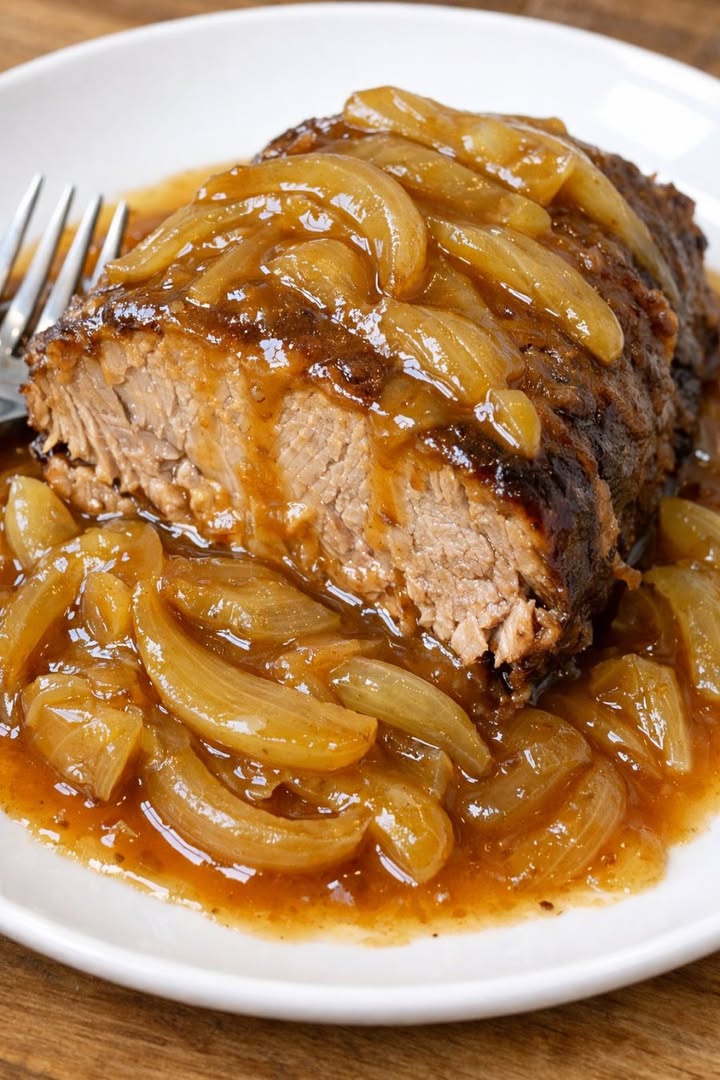
Slow Cooker Amish Onion Gravy Pork Roast
A pork shoulder roast is one of those cuts that rewards patience more than almost any other. Left in a slow cooker for the better part of a day with very little encouragement, it goes from a dense, economical piece of meat to something that yields to a fork with almost no resistance — deeply tender, richly juiced, and fully saturated with whatever it’s been cooking in. This Amish-style recipe provides exactly the right environment for that transformation to happen: a thick bed of sliced yellow onions beneath the roast, two envelopes of dry onion soup mix layered on the onions and pressed into the meat’s surface, and enough beef broth to create the slow-cooking liquid that becomes, by hour eight, a caramel-colored onion gravy that’s arguably better than the pork itself.Cooking & Recipes
Four ingredients, one pot, eight to ten hours of unattended cooking, and what you get is Sunday dinner in the truest sense — the kind that fills the house with fragrance for hours and arrives at the table looking and tasting like you spent the afternoon in the kitchen. The Amish cooking tradition that inspires this recipe understood something that modern cooks sometimes forget: the most satisfying food often comes from the fewest ingredients used thoughtfully, with time doing the work that technique can’t replace.
Why This Recipe Works
The genius of this particular combination is the dual role played by the onions and the onion soup mix, both of which contribute to the finished gravy in complementary ways. The fresh sliced onions break down completely over the long, moist cook, releasing their natural sugars and transforming from pungent raw alliums into something silky, sweet, and deeply savory. The dry onion soup mix provides concentrated seasoning — dehydrated onion, onion powder, salt, and a blend of savory flavorings — that saturates both the meat and the cooking liquid with a rich, complex depth that would take hours of additional cooking to build from scratch.Pork
The placement of the roast fat side up is an important detail. Pork shoulder and pork butt typically have a fat cap on one side, and positioning this facing upward allows the rendering fat to baste the meat continuously as it melts, flowing down the sides of the roast and into the cooking liquid below. This self-basting action keeps the meat moist and adds a layer of richness to both the pork’s surface and the onion gravy that collects around it. The beef broth, rather than pork broth or chicken broth, adds a deeper, more robust savory backbone to the gravy than either lighter option would provide.
Why You’ll Love This Recipe
This is the definition of set-and-forget cooking. Prep takes under ten minutes — slice the onions, open two packets of soup mix, place the roast. Eight to ten hours later you have a meal that serves six generously, with enough braising liquid to spoon over everything and still have some left over. The dish scales down for smaller households and the leftover pork makes exceptional sandwiches the next day, tucked into soft rolls with a spoonful of the reheated onion gravy.Cookware & Diningware
The cost-to-satisfaction ratio is particularly good. Pork shoulder and pork butt are among the most affordable cuts of meat available, and the recipe requires nothing beyond two pantry staples and an onion to produce something that tastes genuinely special. It’s the kind of Sunday roast that people expect to find at the table at their grandparents’ house — warm, filling, savory, and deeply comforting in a way that doesn’t require explanation or qualification.
Ingredient Notes
Boneless pork shoulder or pork butt roast, three to four pounds, is the ideal cut for this recipe. Despite the different names, pork shoulder and pork butt refer to cuts from the same part of the pig — the upper front leg and shoulder area — and can be used interchangeably. Both have the fat marbling and connective tissue that break down during long, low-temperature cooking to produce a moist, tender, deeply flavored result that leaner cuts like pork loin cannot match. Pork loin is sometimes used in slow cooker roast recipes, but it lacks the fat content to stay moist over 8 to 10 hours and can become dry and tight with extended cooking. Pork shoulder is the correct cut — it’s designed for exactly this application. Bone-in pork shoulder can be used in place of boneless; it adds richness to the gravy as the collagen from the bone dissolves into the cooking liquid over the long cook. The bone extends the cooking time slightly — add an additional hour and test for tenderness rather than relying solely on the clock.Meat & Seafood
Dry onion soup mix — two standard 1-ounce envelopes — does the seasoning work for both the meat and the gravy. One envelope goes into the bottom of the slow cooker with the fresh onions; the second is pressed onto the surface of the pork roast. This two-stage application ensures the soup mix flavors the cooking liquid from below and the meat from above simultaneously throughout the cooking time. Lipton’s Recipe Secrets Onion Soup Mix is the most widely available brand; any equivalent dry onion soup mix works identically. The soup mix contains significant sodium — this is why the recipe calls for low-sodium beef broth. Using regular-sodium broth alongside two full envelopes of onion soup mix would produce a dish that’s uncomfortably salty. Taste the finished gravy before serving and add salt only if needed; in most cases the seasoning from the two packets is sufficient.
Yellow onions — two large ones, peeled and thinly sliced from root to tip — form the aromatic base that the roast rests on and contribute the bulk of the gravy’s flavor and body. Sliced root to tip (pole to pole) rather than crosswise keeps the onion strips more intact during the long cook, producing a textured gravy with identifiable onion strands rather than completely dissolved onion. Both presentations are good; it’s a matter of preference for the finished texture. Two large onions is the right amount to cover the bottom of a 5- to 7-quart slow cooker in a substantial layer that the roast can rest on without sitting directly on the insert’s surface. Yellow onions are the best choice here — their combination of sharpness and natural sugar content produces the deepest, most savory-sweet caramelized quality in the finished gravy. Sweet onions (Vidalia) produce a sweeter, milder result. White onions work but produce a slightly less complex flavor than yellow.Soups & Stews
Low-sodium beef broth — two cups — provides the cooking liquid that, combined with the juices released by the pork and the onions as they soften, becomes the rich braising liquid that turns into onion gravy. Beef broth is chosen over chicken or pork broth because its deeper, more robust flavor produces a more complex, darker gravy. Two cups is enough to create a moist cooking environment without submerging the roast — the liquid should come up the sides of the meat without fully covering it, so the top of the roast continues to be exposed to the dry heat inside the slow cooker and the soup mix forms a flavored crust on the surface rather than washing off into the liquid.
Ingredients
3 to 4 lbs boneless pork shoulder or pork butt roast
2 envelopes (1 oz each) dry onion soup mix
2 large yellow onions, peeled and thinly sliced
2 cups low-sodium beef broth
Step-by-Step Instructions
Step 1 — Build the Onion Base
Peel the yellow onions and slice them thinly from root to tip — halve each onion through the root end, place cut side down, and slice in thin strips following the onion’s natural curve. Scatter the sliced onions in an even layer across the entire bottom of a 5- to 7-quart slow cooker insert. The onions should cover the bottom completely, forming a cushion that the roast will rest on and that will slow-cook into the gravy beneath. Sprinkle one full envelope of dry onion soup mix evenly over the onion layer, distributing it as uniformly as possible so the seasoning reaches all parts of the onion bed.Cookware & Diningware
Step 2 — Prepare and Season the Roast
Remove the pork roast from its packaging and pat every surface thoroughly dry with paper towels. Drying the surface of the meat before seasoning helps the dry onion soup mix adhere more evenly and gives the exterior a slightly better texture during the long cook. Place the roast on top of the seasoned onion bed, fat side facing up if there is a visible fat cap on one side of the roast. Pour the second envelope of dry onion soup mix over the top and sides of the pork, pressing it lightly with your hands so it adheres to the meat’s surface and doesn’t slide off when the liquid is added.
Step 3 — Add the Broth
Pour the two cups of low-sodium beef broth carefully around the sides of the roast into the slow cooker, directing the stream away from the top of the meat so as not to rinse the soup mix from the surface. The broth should settle into the onion layer and come up the sides of the roast to a depth of roughly an inch to an inch and a half — enough to create a moist braising environment without submerging the roast. The top of the meat should remain above the liquid level throughout the cook.Soups & Stews
Step 4 — Cook Low and Slow
Cover the slow cooker and cook on LOW for 8 to 10 hours, or on HIGH for 4 to 5 hours. The LOW setting is strongly preferred for this recipe — the slower, gentler heat gives the pork shoulder’s collagen and connective tissue more time to break down into gelatin, which makes the meat more tender and the finished gravy more silky and body-rich than the faster HIGH cook produces. At 8 hours on LOW, check the roast by pressing it with a spoon or fork: it should feel very soft and yield easily to pressure. If it still feels firm or resistant, cover and continue cooking in 30-minute increments until fully tender. The onions should be completely softened and translucent, and the cooking liquid will have deepened to a rich amber-brown color.
Step 5 — Rest the Roast
Carefully transfer the cooked pork roast to a cutting board, allowing any excess braising liquid to drip back into the slow cooker. Tent the roast loosely with aluminum foil and allow it to rest for 10 minutes. This resting period allows the juices that have been driven toward the center of the meat during cooking to redistribute throughout the roast, which means moister, more evenly juiced slices when the meat is cut. Cutting too soon causes the juices to run out onto the cutting board rather than staying in the meat where they belong.
Step 6 — Finish the Gravy
While the roast rests, stir the onions and braising liquid in the slow cooker together to combine them into a unified gravy. Taste the gravy and adjust seasoning if needed — in most cases the two envelopes of soup mix provide sufficient seasoning, but a grind of black pepper can be added if desired. If you prefer a thicker gravy, switch the slow cooker to HIGH with the lid off and allow the liquid to reduce and concentrate for 10 to 15 minutes while the roast rests. For a smoother gravy, use an immersion blender to blend some or all of the onion-liquid mixture directly in the slow cooker until it reaches a uniform, velvety consistency. Both the rustic textured version with intact onion strips and the blended version are excellent.Cookware & Diningware
Step 7 — Slice and Serve
Slice the rested pork roast into thick pieces — it will be tender enough that the slices hold together but yield easily. Arrange the sliced pork on a warm serving platter or directly onto plates and spoon the caramelized onion gravy generously over the top, allowing it to pool around the meat. Serve immediately with your chosen sides alongside.
NEXT PAGE
ADVERTISEMENT
