
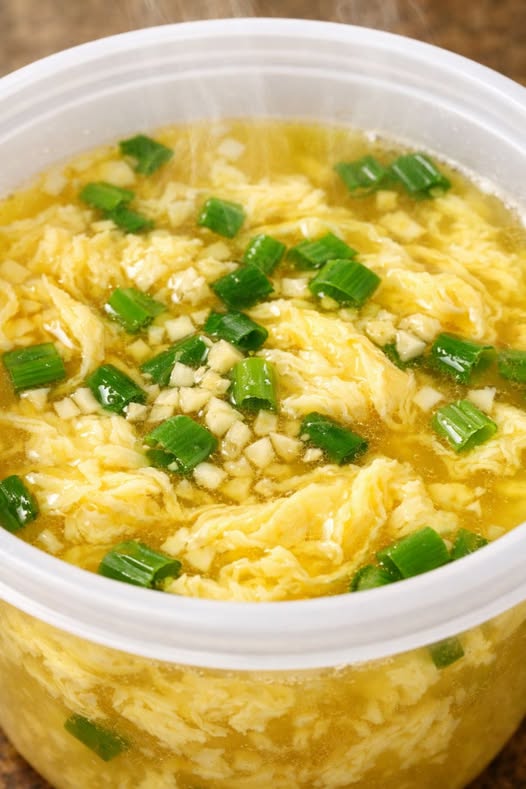
Garlic Egg Drop Soup
Egg drop soup is one of the most efficient soups in existence. Ten minutes, four ingredients, one pot, and the result is a proper bowl of hot, savory, sustaining soup with ribbons of cooked egg floating in a clear, deeply flavored broth. There’s almost nothing to it in terms of technique, but the technique that exists — the way the eggs are drizzled in a slow, thin stream into simmering broth while the soup is kept moving — produces that distinctive silky, wispy egg ribbon texture that makes egg drop soup satisfying in a way that scrambled eggs dropped in broth simply isn’t.Fruits & Vegetables
This version adds garlic to the classic combination, which is a straightforward upgrade that meaningfully deepens the broth’s flavor. Garlic simmered in chicken broth for two to three minutes loses its raw sharpness and becomes mellow, aromatic, and integrated — the kind of background depth that makes people say the soup tastes like something special rather than something improvised from pantry basics. With green onion both cooked in the broth and scattered fresh on top, the four-ingredient soup covers its bases: savory depth, aromatic brightness, protein from the eggs, and the fresh herbal note that makes each bowl feel complete.
The Technique Behind the Ribbons
The characteristic silky, ribbon-like texture of egg drop soup comes entirely from technique rather than any special ingredient. It requires two things happening simultaneously: the eggs entering the broth in a thin, controlled stream rather than all at once, and the soup being stirred continuously in one direction while the eggs are added. Both conditions need to be met for proper egg ribbons to form.Dairy & Eggs
When beaten eggs hit hot broth all at once without stirring, they form large, shapeless clumps of cooked egg — edible, but not the delicate, flowing ribbons that make egg drop soup visually appealing and texturally pleasant. The thin stream breaks the egg mass into smaller parcels before they hit the hot broth; the continuous stirring in one direction sets up a current in the liquid that stretches those small parcels of egg into long, wispy strands as they cook on contact with the hot liquid. The stirring direction matters because opposing the direction mid-stream disrupts the current and breaks the ribbons into shorter, less elegant pieces.
The broth temperature also matters. A gentle simmer — small bubbles forming around the edges, not a rolling boil — is the right state for egg addition. A rolling boil creates too much agitation in the liquid, which disrupts the current your stirring creates and produces choppier, less elegant egg pieces. Turn the heat down slightly from wherever it was when you brought the broth to a simmer before adding the eggs.Soups & Stews
Why You’ll Love This Recipe
Speed is the primary appeal. From cold broth to finished soup in ten minutes — faster than any delivery order, faster than most canned soups from the pantry, and considerably more satisfying than either. This is genuinely useful cooking for the moments when you need something warm and sustaining immediately and have almost no time or energy to invest. The four-ingredient simplicity means everything needed is almost certainly already in the kitchen.
Beyond speed, the soup is genuinely nourishing. Three eggs in two servings provides meaningful protein; the garlic-infused chicken broth is warming and savory; the whole dish is naturally low in carbohydrates, making it particularly useful as a quick light meal or as the start of a larger meal. It scales easily for more people — simply increase the broth, eggs, and garlic proportionally, keeping the basic method identical. And it reheats well, making it a practical choice for meal prep: a double or triple batch made on Sunday can be portioned into containers and reheated throughout the week in under two minutes.Fruits & Vegetables
Ingredient Notes
Low-sodium chicken broth — three cups for two servings — is the soup’s liquid base and primary flavor vehicle. Low-sodium broth is specified because the eggs and garlic provide no additional salt, so the broth’s seasoning level is the soup’s entire seasoning baseline. Regular-sodium broth can produce an uncomfortably salty finished soup, particularly since the broth concentrates slightly during the brief simmer. Good-quality broth makes a meaningfully better soup than a lower-quality one — in a recipe this simple, the broth’s flavor is directly perceptible in every spoonful. Bone broth is an excellent upgrade that adds additional richness and body to the finished soup from the dissolved collagen; it produces a slightly more viscous, richer result. Vegetable broth can be substituted for a fully vegetarian version; the flavor will be lighter and less savory than the chicken version but still very good.
Eggs — three large, well-beaten — are the protein component and the textural element that makes egg drop soup distinctive. The beating is important: poorly beaten eggs where the white and yolk aren’t fully combined will produce uneven egg ribbons with visible streaks of white and yellow rather than the uniform, pale yellow ribbons of a properly beaten egg mixture. Beat until the mixture is completely homogeneous — 30 to 45 seconds of vigorous fork-beating achieves this. Using a measuring cup or small bowl with a pour spout for the beaten eggs gives you more control over the stream when drizzling into the broth than working from a regular bowl.Dairy & Eggs
Garlic — three cloves, minced, or one tablespoon of jarred minced garlic — is simmered in the broth before the eggs are added. Fresh garlic minced just before use has a brighter, more complex flavor than jarred garlic, which has a slightly fermented character from sitting in liquid; both produce a very good result in this application, and the difference is less noticeable in a soup than in a raw preparation. Three cloves is the right amount for a clearly garlic-flavored broth that’s assertive without being overwhelming — a single dominant flavor note rather than a vague background hint. For a more intense garlic character, increase to four cloves.
Green onions (scallions) — two tablespoons chopped, divided — serve two distinct roles in this soup. Half goes into the broth at the beginning of the cook, softening and infusing the broth with a mild, herbal onion flavor over the simmer time. The remaining half is scattered over the finished soup as a garnish, where it provides a fresh, crisp, slightly sharp contrast to the warm, mellow broth. This divided use — cooked and fresh — is a simple technique that produces more flavor complexity from a single ingredient than using it all in either role alone.Soups & Stews
Ingredients
3 cups low-sodium chicken broth
3 large eggs
3 cloves garlic, minced
2 tbsp chopped green onions (scallions), divided
Salt, to taste
Optional: sesame oil, white pepper, soy sauce, red pepper flakes for serving
Step-by-Step Instructions
NEXT PAGE
ADVERTISEMENT
