
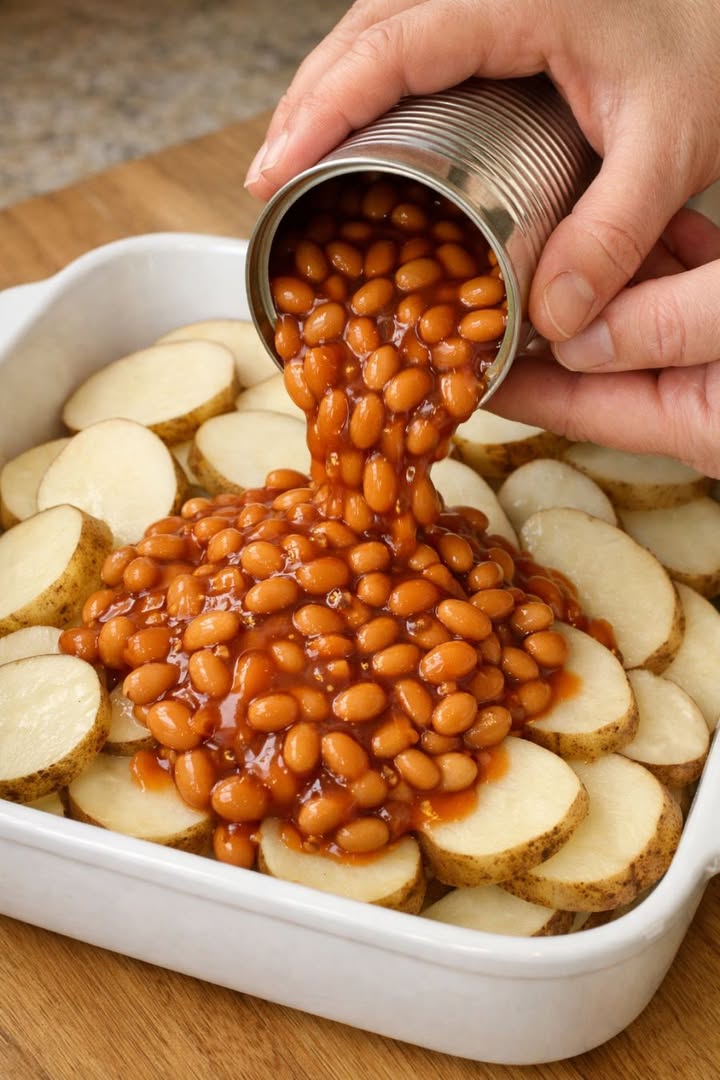
Amish Baked Bean and Potato Casserole
Baked beans and potatoes belong together in the same way that a number of great pairings do — both starchy, both filling, both deeply satisfying on their own, and somehow even better when combined. This casserole takes the simplest possible approach to bringing them together: raw sliced russet potatoes layered in a greased ceramic baking dish, two cans of baked beans poured over the top, and a covering of sharp cheddar added in the final fifteen minutes of baking. The oven does the rest. The beans slowly seep between the potato slices during the covered bake, the potatoes cook through in the bean sauce, and by the time the foil comes off and the cheddar melts to a bubbling golden layer on top, the casserole has become something that tastes thoroughly cooked and carefully assembled despite requiring about ten minutes of active preparation.Grains & Pasta
The inspiration is Amish-style baked bean casseroles that appear across Midwestern church potlucks and community cookbooks — dishes built around economical pantry staples that manage to taste homey and satisfying from ingredients that cost very little. Bean and potato combinations have fed working families in this tradition for generations, and the version with cheese on top is the kind of thing that appears reliably at gatherings because it travels well, holds at serving temperature without degrading, and everyone eats it.
Why This Recipe Works
The method depends on one important principle: the baked beans function as both the sauce and the cooking liquid for the potatoes. When the foil-covered dish goes into the oven, the heat causes the bean sauce to liquify and thin slightly, seeping down through the layers of potato slices and surrounding each one in the sweet-savory tomato bean liquid. The potatoes cook in this liquid rather than in plain water, which means they absorb the beans’ flavor throughout rather than just on the surface. By the time the potatoes are fully tender — 45 to 55 minutes depending on slice thickness — every potato layer is seasoned, slightly saucy, and tasting of the beans it cooked in.Horticulture
The covered bake followed by an uncovered cheese finish is a standard and well-proven casserole technique. The foil traps steam that helps the potatoes cook through evenly without the top surface drying out or the bean sauce reducing too quickly. Once the potatoes are tender, the foil comes off, the cheese goes on, and the final 10 to 15 minutes of uncovered baking melts and browns the cheddar into the golden, slightly blistered topping that makes the finished casserole look as appealing as it tastes.
Why You’ll Love This Recipe
This is genuinely a default weeknight dinner in the best sense — something that can be assembled and in the oven in under fifteen minutes, produces a filling and satisfying result from four pantry ingredients, and requires almost no active attention during its hour-plus baking time. For households that regularly face the “what are we having for dinner” problem without much advance planning, a casserole that goes from pantry to table with minimal thought and effort is genuinely valuable.Cookware & Diningware
The cost is another appeal. Russet potatoes, canned baked beans, and cheddar cheese are among the most economical ingredients available at any grocery store. The total ingredient cost for four servings is minimal — this is honest, budget-friendly cooking that doesn’t require any compromise on taste or satisfaction. The casserole is filling enough that four modest portions serve a full dinner without requiring multiple sides, though the recipe scales easily for larger households.
Ingredient Notes
Russet potatoes — 1½ pounds, scrubbed and thinly sliced — are the right potato for this casserole. Russets are high-starch and break down somewhat during the long bake, softening to a yielding, slightly creamy texture inside the bean sauce that integrates well with the casserole’s character. Their mild flavor absorbs the sweet-savory bean sauce without competing with it. Slice them to a thickness of 1/8 to 1/4 inch — thin enough to cook through completely in the covered bake time without requiring the dish to stay in the oven so long that the beans reduce to an overly thick paste. A mandoline slicer set to this thickness produces perfectly consistent slices quickly; a sharp knife and careful technique work just as well. Leaving the skin on produces a more rustic character and retains the skin’s nutrients; peeling produces a more uniform-looking finished casserole. Both are appropriate choices. Yukon Gold potatoes can be substituted for a slightly waxier, more butter-flavored result with slices that hold their shape more distinctly through the bake — a good choice if you prefer the potato to remain more textural rather than softening fully into the beans.Grains & Pasta
NEXT PAGE
ADVERTISEMENT
