
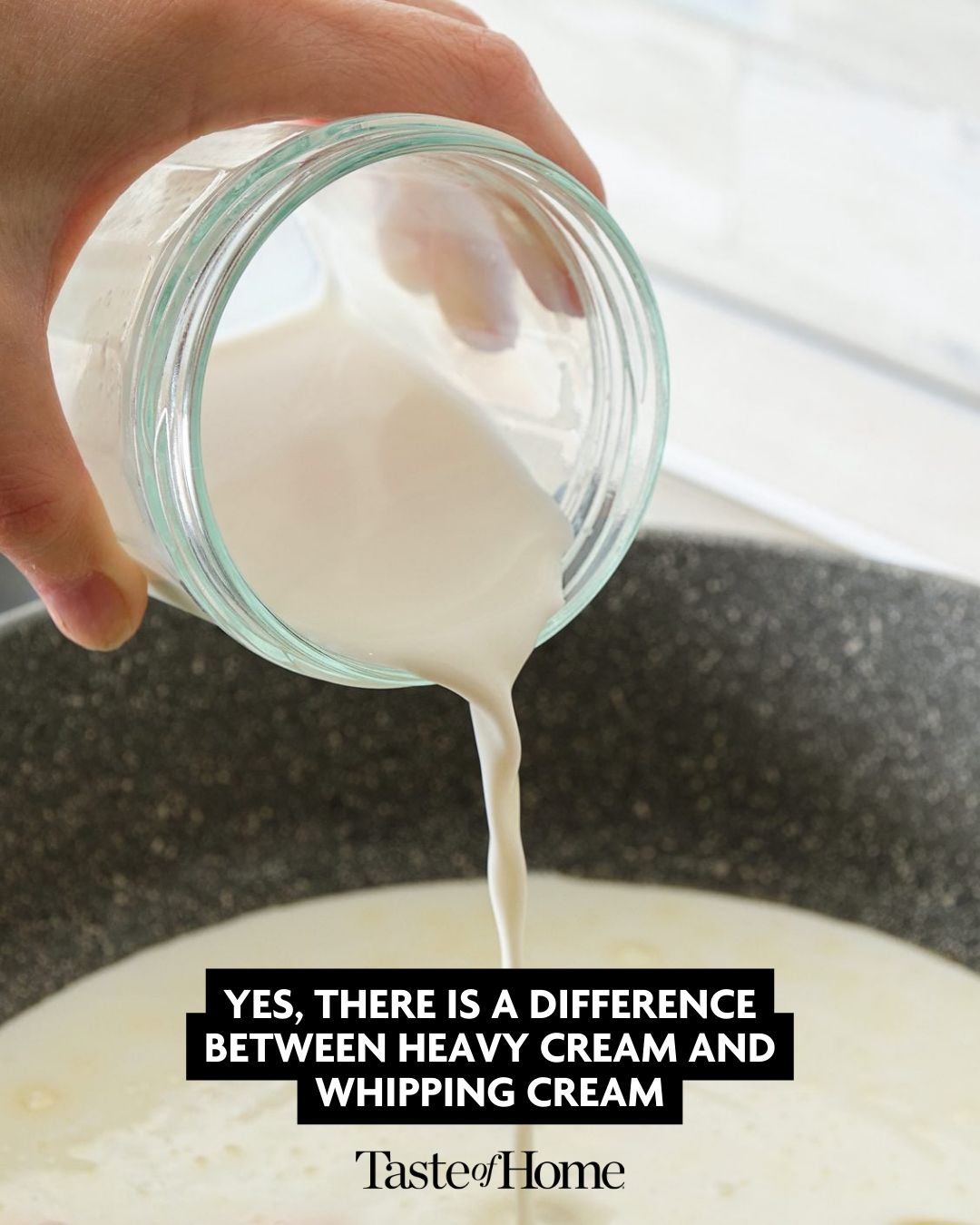
Confused about which type of cream to buy? Learn about heavy cream vs whipping cream so your recipe turns out just right.
You’re in the dairy aisle looking at all the different creams. There’s heavy whipping cream, heavy cream and whipping cream. How do you know what to buy when you want to make whipped cream, cream sauce or creamy potato soup? What about when the store is out of your first choice and you need a substitute?
Here’s an explanation of heavy cream vs whipping cream to help you understand what’s behind each product’s name.
Heavy Cream vs. Whipping Cream
Laws determine which products can be labeled and sold as cream in the United States. These laws are spelled out in a tome called the Code of Federal Regulations. One section of the code describes heavy cream, and another section describes whipping cream.
What Is Heavy Cream?
Heavy cream (also called heavy whipping cream) must contain at least 36% milkfat. It must be pasteurized or ultra-pasteurized to kill harmful bacteria. It does not have to be homogenized. (Homogenization disperses fat globules throughout for a uniform creaminess; non-homogenized dairy products have the cream floating on top.)
It also doesn’t have to be pure cream. The FDA allows producers to add certain ingredients to heavy cream, including emulsifiers, stabilizers, sweeteners and flavorings. The product must be labeled as such.
For comparison, light cream has 18% to 30% milkfat, and half-and-half has 10.5% to 18% milkfat. Milk contains at least 3.25% milkfat.
What Is Whipping Cream?
Federal regulations don’t set standards for “whipping cream,” but rather for light whipping cream. It must have 30% to 36% milkfat. Just like heavy cream, it can also have flavorings or sweeteners added, can be homogenized or not, and must be pasteurized or ultra-pasteurized, and these things should be noted on the label.
NEXT PAGE
ADVERTISEMENT
